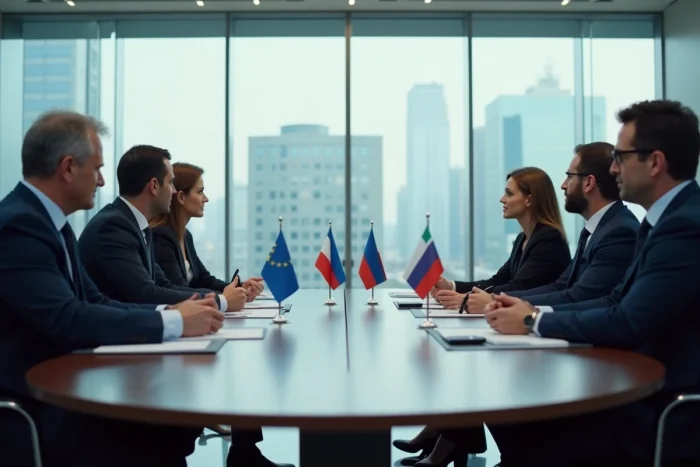
When a French company wants to sell industrial equipment in Kazakhstan or import Uzbek cotton, it no longer follows the same path as it did four years ago. Sanctions against Russia, tightening banking regulations, and the rise of new partners have reshaped the trade landscape between France and the Commonwealth of Independent States. By 2026, these movements are accelerating.
Caucasus and Central Asia: New Trade Axes for France with the CIS
Before 2022, Russia captured the vast majority of French exports to the CIS region. This flow has significantly contracted due to successive European sanctions. French companies have redirected their efforts towards more accessible markets.
Specifically, Kazakhstan, Uzbekistan, Azerbaijan, and Georgia now absorb an increasing share of French exports in the region. The promising sectors include energy, industrial equipment, and digital services. To better understand trade between France and the CIS, one must look at these emerging trade corridors rather than just the Paris-Moscow axis.
Why these countries specifically? Kazakhstan has considerable energy resources and is investing in modernizing its infrastructure. Uzbekistan, with its young population and recent economic opening policy, attracts suppliers of agricultural and industrial equipment. Azerbaijan remains a key energy partner for Europe, and Georgia plays a logistical hub role between Europe and Central Asia.
Sanctions and Banking Compliance: The Real Barrier to France-CIS Trade
The main obstacle for French companies in 2026 is not demand. It is compliance. The European sanction packages adopted between 2022 and 2024 target Russia and Belarus, but their effects spill over significantly to neighboring countries.
French banks have tightened their compliance policies across the entire CIS region, including for non-sanctioned countries. This phenomenon has a technical name: “de-risking.” Rather than evaluating each operation on a case-by-case basis, some institutions prefer to refuse financing related to Central Asia outright.
For an SME exporting spare parts to Tashkent, this translates into concrete difficulties:
- Closure of bank accounts related to operations with CIS counterparties, even in countries not targeted by sanctions
- Refusal of letters of credit or bank guarantees for transactions that are nonetheless legal
- Lengthening of verification times, sometimes by several weeks, on routine payments
The European Commission’s guidelines on preventing sanctions circumvention, published between 2023 and 2024, have reinforced this caution. The perceived legal risk often exceeds the actual risk, which blocks perfectly legal operations.
Local Currencies and Yuan: A Parallel Payment System in the CIS
Have you noticed that more and more trade transactions worldwide are settled in Chinese yuan? In the CIS, this movement is particularly visible. The increasing use of local currencies and the yuan in intra-CIS transactions, especially with Russia, is reshaping the financial circuits of the region.
For French exporters, this evolution poses a practical problem. Invoicing in Kazakh tenge or Uzbek soum adds a currency risk that mid-sized companies rarely manage effectively. The classic hedging tools offered by French banks are calibrated for the euro, dollar, or major Asian currencies, not for Central Asian currencies.
This gap creates a competitive advantage for Chinese or Turkish companies, which are accustomed to operating in these currencies. French exporters who want to remain competitive in 2026 will need to either negotiate contracts in euros (which is not always accepted) or develop specific financial expertise for the region.
Eurasian Economic Union and Regional Integration: What This Changes for France
The Eurasian Economic Union (EAEU), which includes Russia, Belarus, Kazakhstan, Armenia, and Kyrgyzstan, is increasingly structuring the trade rules of the region. The technical standards and customs procedures of the EAEU are gradually harmonizing, which can simplify market access for a foreign exporter, provided they understand the regulatory framework.
A concrete example: a French manufacturer of medical equipment that obtains certification compliant with EAEU standards can theoretically access all five member markets with a single application. In practice, national application differences remain real, but the trend is toward unification.
The paradox for French companies is as follows. Regional integration facilitates access to Kazakhstan or Armenia, but it also strengthens these countries’ economic ties with Russia. Any business strategy in the region must take this dual dynamic into account: openness to European suppliers on one side, Russian economic gravity on the other.
2026 Outlook for French Exporters to the CIS
French leaders who are internationalizing in 2026 prioritize action over inaction, according to the Barometer of French Leaders conducted by Eurogroup Consulting in partnership with the French Foreign Trade Advisors. This proactive stance is confirmed in the CIS region, where opportunities exist despite regulatory complexity.
The most promising sectors for French companies remain:
- Equipment for energy transition, particularly in Kazakhstan and Uzbekistan, which are modernizing their networks
- Digital services and business software, areas where French expertise faces little local competition
- Processed agri-food products, with growing demand in major cities of Central Asia
France also maintains its position as the top European destination for foreign direct investment, which enhances its credibility as a trade partner for CIS countries seeking to diversify their economic relations beyond Russia and China.
The main challenge for 2026 remains access to banking financing for operations towards the CIS. Companies that can combine rigorous regulatory monitoring of sanctions with a deep understanding of local financial circuits will be best positioned in these rapidly evolving markets.