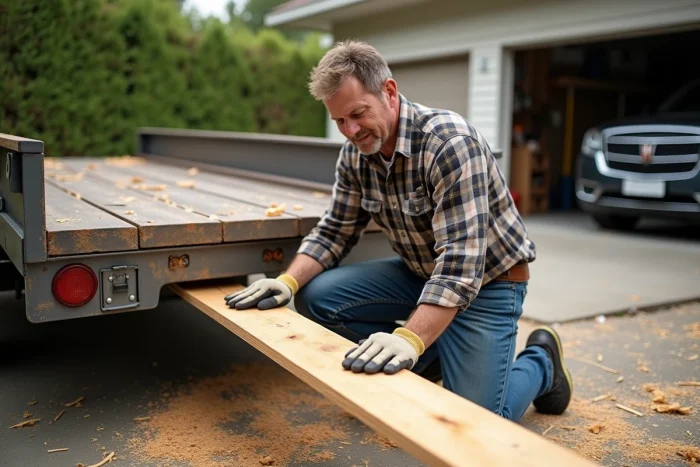
A poorly secured wooden floor leads to premature wear of the equipment and safety risks during transport. Some professionals still opt for temporary solutions, which are prohibited by regulations. Others are unaware that the choice of wood species directly impacts load resistance and thermal insulation.
Each type of covering has specific constraints regarding fixing and maintenance. The distribution of weight and space optimization also depend on the chosen installation method, often overlooked during the initial van layout.
Why the choice of wooden floor is fundamental for your van’s layout
Choosing a wooden floor for a trailer goes far beyond mere appearance. The real issue lies in the material’s robustness, its ability to withstand loads, resist moisture, and provide thermal insulation that meets the van’s needs. The floor rating, which measures the floor’s resistance to pressure, especially during the passage of a forklift, should always guide the choice, well before comparing prices per square meter. The thickness of the wood (usually between 9 and 15 mm depending on usage), its treatments, and its quality directly determine the durability of your utility vehicle.
With the diversity of materials, it becomes essential to consider the type of trailer, the PTAC (authorized total weight), and the intended use. Transporting heavy loads? No compromises possible: the floor must be perfectly sized for the cargo, the passage of wheeled equipment, and ambient humidity. Solid wood, plywood, composite panels, each solution has its advantages and limitations, both for installation and daily maintenance.
To preserve your floor, apply water-repellent treatments, either with paraffin or polyurethane. Humidity remains the number one enemy: it deforms, rots, and weakens. A non-slip covering protects both people and cargo. Do not neglect compliance with standards: DTU 51.3, NF EN 13986+A1, NF EN 14342, CE marking, all serve as benchmarks to ensure a reliable product.
Want to delve deeper into fixing techniques and selection? Specialized resources like wooden floor for trailer Brico Dépôt detail solutions tailored to each scenario.
Which materials and coverings to prioritize according to your needs and uses
The choice of material determines the reliability and durability of the floor, whether it is a utility van, a flatbed trailer, or a converted vehicle. Solid wood promises robustness and authenticity, especially in pine or oak, while marine plywood is favored for its increased resistance to moisture and dimensional stability. Birch plywood remains popular for its density and longevity, suitable for transporting heavy loads.
Composites that combine wood and plastic or polyester provide lightness and corrosion resistance, ideal for intensive use or trailers exposed to significant climatic variations. Some panels, like Wingolite, combine lightness and mechanical strength, facilitating handling while maintaining safety.
To enhance protection, it is advisable to choose a non-slip and water-repellent covering. Treatments with paraffin or polyurethane, or solutions like Waxin or P.U.R, effectively stop water infiltration. Compliance with DTU 51.3 or NF EN 13986+A1 standards ensures consistent quality. Depending on the transported volume and type of load, adjust the thickness (9 to 15 mm) to meet the constraints of the floor rating and the pressure during loading or unloading phases.
Here are the main options to consider based on your usage:
- Marine plywood: outdoor use, exposure to moisture
- Solid wood: robustness, aesthetics, high loads
- Composite: reduced weight, industrial use
Expert tips for solid fixing and optimized storage space
The way you fix the wooden floor directly influences the stability of the entire layout. Installing on joists or bearers allows for uniform load distribution, limiting the risk of deformation, especially with temperature and humidity variations. Prefer stainless steel screws to avoid corrosion, and choose rivets that are compatible with the chassis structure. For durable support, space the anchoring points 40 to 60 cm apart.
Enhance the longevity of the floor with protective corners at the angles, effective against shocks and wear, and sealing joints around the perimeter, which limit water penetration, a sensitive point for any trailer floor that may face bad weather or heavy outdoor use.
Storage optimization and equipment fixing
Consider utilizing every nook by installing battens or rails to organize storage. Removable modules can be securely fixed to the floor without weakening it, using appropriate screws and through anchors if necessary. This method allows you to adapt the layout of your van or trailer according to needs, without compromising safety.
Here are some good practices to keep in mind to ensure the longevity of the wooden floor:
- Regular cleaning combined with moisture protection preserves the floor’s performance.
- Always check the compatibility of the fixing with the chosen wood and the load to be transported.
A well-thought-out, solid, and protected floor transforms every journey into a promise of serenity. The trailer is no longer just a tool, but a reliable ally, ready to face every mission without faltering.