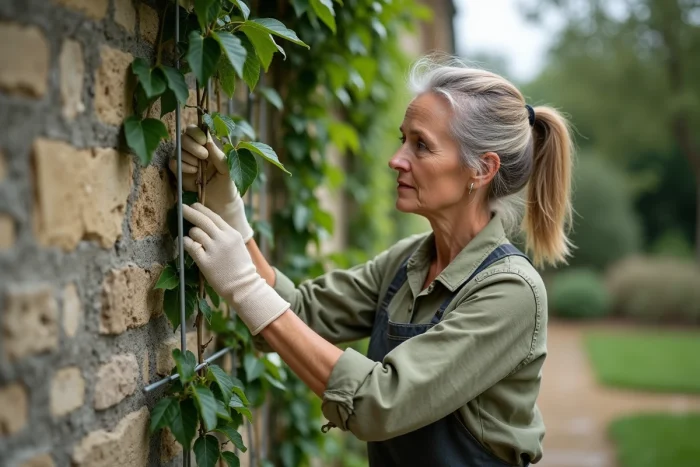
The climbing jasmine, whether starry (Trachelospermum jasminoides) or common, does not cling to a wall by itself. Unlike ivy or virgin vine, its twining stems need a support to wrap around. This characteristic requires choosing a suitable fixing system based on the type of wall, and then guiding the plant for several seasons to achieve uniform coverage.
Trellis, cables, or taut wires: which support to choose for climbing jasmine on a wall
The choice of support affects both the stability of the plant and the health of the wall. A support that is too rigid pressed against the façade retains moisture, while a device that is too flexible cannot withstand the weight of a mature jasmine.
| Type of support | Spacing from the wall | Weight resistance | Facade aeration | Suitable for starry jasmine |
|---|---|---|---|---|
| Wooden trellis | Low (often pressed) | Medium | Limited | Yes, but needs to be offset from the wall |
| Tensioned stainless steel cables | Adjustable (spacers) | High | Good | Yes |
| Galvanized wire | Adjustable | Medium | Good | Yes, needs regular tensioning |
| Welded mesh | Variable | High | Medium | Yes, aesthetic is debatable |
The stainless steel cables on spacers offer the best compromise between robustness, aeration, and discretion. They allow for a few centimeters of space between the vegetation and the façade, which reduces stagnant moisture and facilitates pruning interventions.
The wooden trellis remains popular, but it must be fixed on spacers to lift it off the wall. Without this gap, air circulation is insufficient and mold may appear on the plaster.
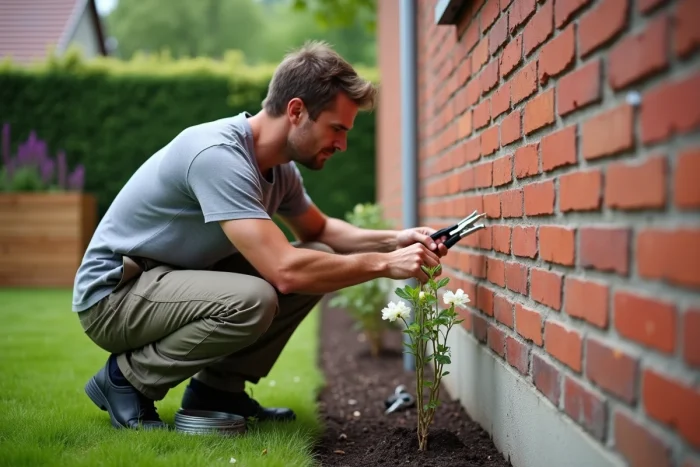
A detailed guide explains how to attach climbing jasmine to a wall based on the façade material and the type of support chosen.
Fixing on an externally insulated wall: the trap to avoid
On recent façades with external thermal insulation (ITE), the insulation layer cannot support the weight of a loaded trellis or the stress of a screw anchor. The support must be anchored in the load-bearing masonry, not in the polystyrene or rock wool that covers the wall.
Drilling into the insulation layer without caution creates a thermal bridge and can compromise the waterproofing of the façade. There are through-fixings with insulating sleeves designed for this scenario. A mason or facade worker can check the thickness of the insulation before installation.
On an old stone or brick wall, the problem does not arise. Dowels suitable for the material (expansion dowel for concrete, chemical dowel for crumbly stone) are sufficient to hold the hooks or cable plates.
Guiding the stems of starry jasmine to cover a wall without empty spots
The growth of starry jasmine is vigorous once the plant is well established, but it naturally focuses upwards. Without intervention, the base of the wall becomes bare while the top forms a dense mass.
Fan training from the first year
Fan training involves spreading the main stems diagonally right from planting. Each stem is tied to the support with a soft tie (raffia, foam tie, or biodegradable tie) allowing some slack to avoid strangling the stem as it grows.
- Soft ties like raffia or foam: they decompose before compressing the stem, preventing strangulation
- Rigid plastic ties or bare wire: to be avoided, as they cut into the bark and create entry points for diseases
- Reusable clip ties: practical for frequent adjustments, but should be checked each season to ensure they are not too tight
Directing the stems laterally rather than vertically encourages the appearance of new shoots along the entire length. The plant perceives the horizontal position as a signal to produce lateral branches, which densifies the coverage.
Frequency of training and maintenance pruning
During the first two years, a monthly check in spring and summer is sufficient to redirect new shoots. After summer flowering, light pruning helps control congestion and encourages branching for the following season.
Stems that stray too far from the support or grow perpendicular to the wall are brought back to the training plane. This regular discipline yields a much more uniform result than a radical annual intervention.
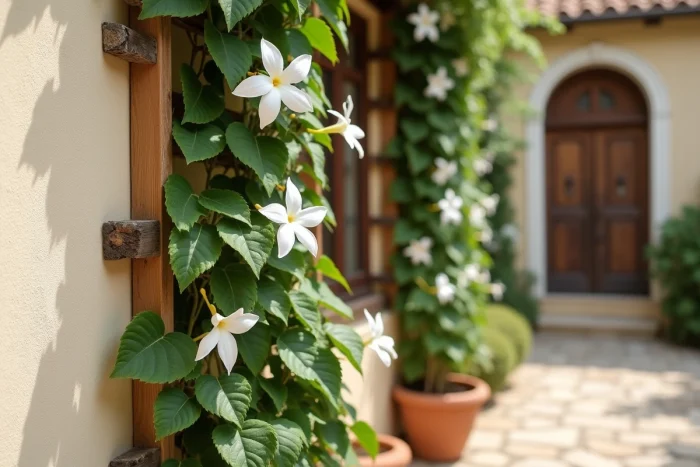
Space between the wall and climbing jasmine: why a few centimeters make all the difference
The current trend in ornamental gardening is to pull the support away from the wall rather than pressing it against it. A spacing of three to five centimeters improves air circulation behind the foliage, reducing the risk of moisture retention on the façade.
On a wall exposed to the wind, a flexible and spaced support absorbs movements better than rigid slats screwed flush with the plaster. Tensioned cables have this advantage: they oscillate slightly without transmitting all the stress to the fixings.
- North-facing or poorly ventilated wall: prefer a wider gap to compensate for the lack of natural drying
- South-facing wall: spacing remains useful to avoid overheating of the foliage pressed against a burning surface in summer
- Wall in a windy area: prefer stainless steel cables with tensioners rather than a rigid trellis that offers significant wind resistance
This technical detail, often overlooked during installation, determines the longevity of the training. A well-aerated starry jasmine remains healthy longer and requires fewer treatments against fungal diseases.
Climbing jasmine on an exterior wall remains a sustainable solution provided that the support fixing and guidance during the first years are well managed. The choice between cables, trellis, or wires depends on the type of façade and exposure. Once the system is in place and the stems are fanned out, the plant takes over and gradually covers the surface with little maintenance.