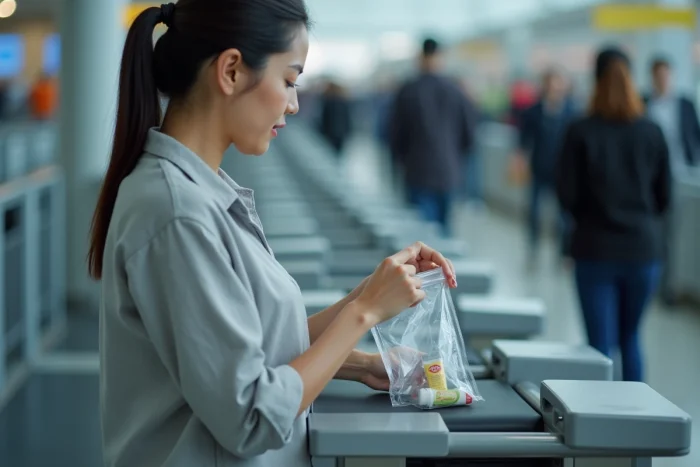
You are preparing your toiletry bag before a flight and are unsure about the tube of toothpaste. Can it pass through security as is, or do you need to transfer it, replace it, or even abandon it? The answer depends on the format, the container, and sometimes the texture of the product. Here’s what to remember to board without any unpleasant surprises.
Clay-based or natural toothpastes: a special case at security
Classic tube toothpastes are treated as pastes, thus subject to the same restrictions as liquids. Natural or clay-based formulas pose an additional problem: their consistency is often thicker than a standard gel.
At the scanner, a security agent cannot distinguish the chemical composition of the product. They evaluate the container and the visible texture. A very pasty clay toothpaste is still classified as a paste, even if it resembles a thick cream more than a fluid gel. Therefore, the rule of a maximum 100 ml container applies in the same way.
The concrete trap: many natural cosmetic brands package their toothpastes in glass jars or opaque tubes without volume graduation. If nothing clearly indicates the capacity on the packaging, the agent may consider that the product exceeds the limit and confiscate it. Before leaving, check that the container clearly displays its capacity. Learning more about toothpaste in cabin luggage helps clarify these gray areas.
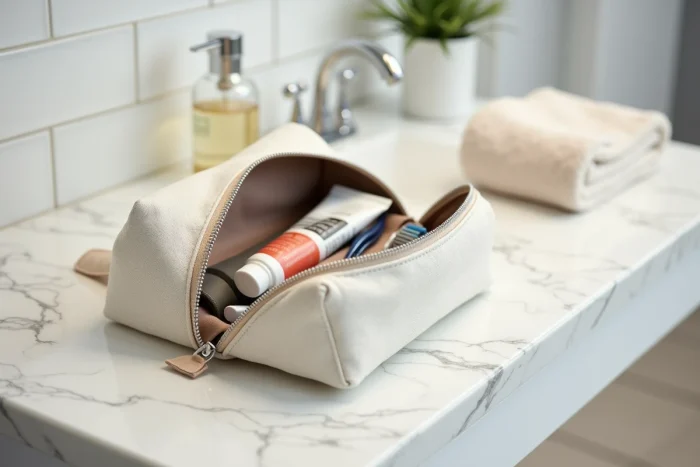
100 ml rule in cabin luggage: what the regulations cover exactly
European regulations require that each container of liquid, gel, paste, or aerosol carried in cabin baggage does not exceed 100 ml. All these containers must fit into a single transparent, resealable plastic bag, with a maximum capacity of one liter.
You are allowed to carry multiple tubes of toothpaste, provided each complies with this limit and the total fits in the transparent bag. A 75 ml tube and a second 50 ml tube pass without issue as long as the bag is not saturated with other products.
- Container of 100 ml maximum per item, even if the tube is only half full (it’s the indicated capacity that counts, not the remaining volume)
- One transparent, resealable plastic bag per passenger, approximately 20 x 20 cm
- Toothpaste, shower gel, sunscreen, shampoo: all fall into the same category and share the space of the bag
Variable application depending on airports
Travelers reported in 2025 confiscations of tubes exceeding the limit by just a few milliliters, even when placed in the regulatory bag. The application of the rule varies from one airport to another and from one agent to another. Allow for a margin: a 75 ml tube passes everywhere, while a tube exactly 100 ml can create a debate.
Solid and tablet toothpastes: the real alternative without volume restrictions
In recent years, chewable tablet or powder toothpastes have gained traction among regular travelers. Their main advantage on a plane is simple: a solid toothpaste is not subject to the liquid rule.
In practice, you can slip a jar of dental tablets into your cabin luggage without placing it in the transparent bag. There’s no quantity limit related to the format. This is a real space saver when your one-liter bag is already occupied by serum, moisturizer, and deodorant.
Dental powder: beware of presentation
Loose powder toothpastes can sometimes raise questions at security. A small jar filled with white powder may trigger an additional inspection. Keep the original packaging with the visible label to avoid unnecessary waiting time at the security checkpoint. A transparent bag without identification helps no one.
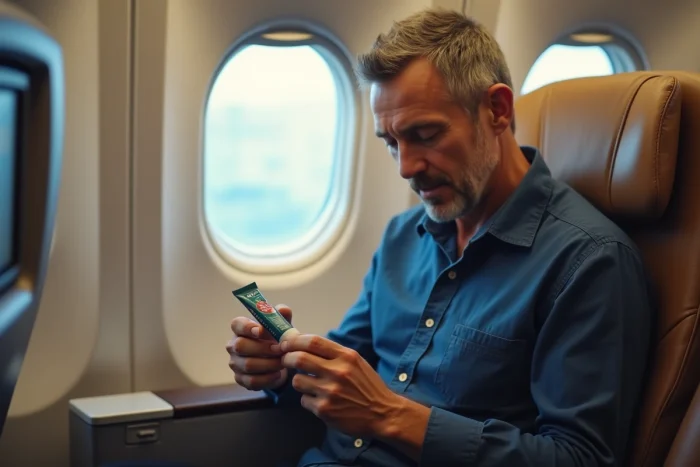
Preparing your toiletry bag for a flight: choices that make a difference
Rather than transferring your usual toothpaste into a mini bottle, ask yourself: do you really need a tube in the cabin? For a short or medium-haul flight, a dental tablet is sufficient. For a long-haul flight with a stopover, a 75 ml travel-sized tube covers several days.
- For a flight of less than six hours: one or two solid toothpaste tablets in a small container are enough
- For a multi-day trip with cabin luggage only: a 75 ml tube optimizes space in the transparent bag
- For a long stay with checked luggage: place your large tube in the checked suitcase, where the limit per container is much more generous
Comparison Canada and Europe
In Canada, the ACSTA applies the same general 100 ml rule for liquids in cabin luggage, without specific restrictions on toothpaste beyond this threshold. The difference mainly lies in the rigor of application: traveler feedback indicates less strict checks on thick textures in North America than in Europe. Check the rules of the departure country, not just those of the destination.
The format of your toothpaste alone determines whether it will pass through security. A properly labeled 75 ml tube in a transparent bag poses no problem. A solid toothpaste completely frees you from this constraint. The choice depends on the duration of the flight and what is already in your toiletry bag.