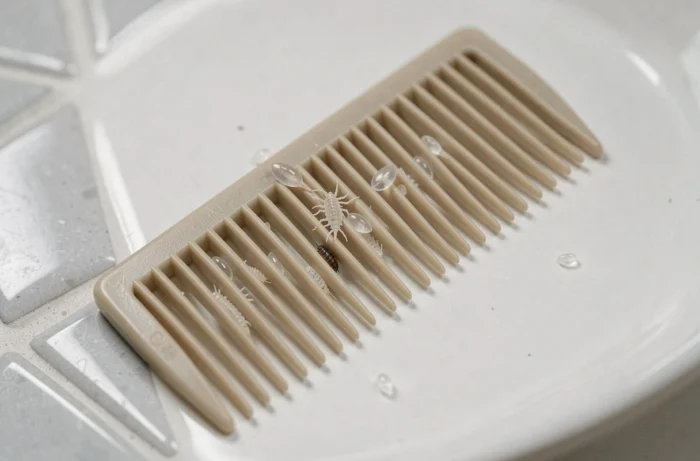
A fine-toothed comb is run through a child’s hair after treatment, and a small “crack” is heard. Immediate reflex: one thinks that the louse has just burst, a sign that the treatment has worked. This interpretation is common among parents, but it is based on a confusion between what is heard and what actually occurs on the scalp.
Understanding where this surprising crack comes from helps avoid a false sense of security and properly check if the infestation is over.
What the comb actually produces on treated hair
When a fine-toothed comb is removed from a strand after applying a dimethicone-based product, several elements get caught in the teeth: broken hair, dried product residue, dandruff, and nits stuck to the hair shaft. The dry sound perceived can come from any of these elements.
The nits are cemented to the hair by a very strong natural glue. When the comb pulls out a nit, the hair shaft experiences a sudden tug that can produce a micro-crack. A weakened hair that breaks cleanly generates the same type of sound. In both cases, the noise does not come from a louse bursting.
You can also hear this crack on a head without any lice, simply by combing dry and damaged hair. To convince yourself, just run the same fine-toothed comb through non-infested hair after a drying treatment: the sound is comparable. Those who wish to delve deeper into the sound of dead lice will find this same analysis on a physiological level.

Dead louse after treatment: the real verification criteria
The CDC recommends basing the diagnosis on the direct observation of a live louse moving, not on a noise or tactile sensation. A dead louse has specific visual characteristics that can be checked with the naked eye or with a magnifying glass.
Visual signs of a dead louse on the comb
- Dark brown color, sometimes blackish, whereas a live louse is more translucent gray-brown and adapts to the hair color.
- Total immobility: a live louse reacts to light and tries to escape. A dead louse remains inert even if pushed with the tip of the comb.
- The dead louse detaches easily from the hair, whereas a live louse clings with its six hooked legs.
Wet combing method to confirm
The most reliable technique involves wetting the hair, applying a thick detangler, and then combing through strand by strand from the root. The comb is wiped on a white absorbent paper after each pass.
On the paper, everything becomes readable. A live louse moves in the seconds that follow. A dead louse remains still. Empty nits appear white and translucent. The white paper replaces the ear as a diagnostic tool.
Dead or live nits: distance from the scalp as an indicator
Nits pose a distinct problem. Even after effective treatment, they remain stuck to the hair for weeks. Their prolonged presence fuels parents’ anxiety, who sometimes associate the sound of combing with a persistent infestation.
A nit located more than one centimeter from the scalp is generally empty or dead. The hair grows, and the nit moves away from the heat zone necessary for incubation. Close to the scalp, however, a brown and bulging nit may still contain a viable embryo.
Color also helps: a live nit is brownish, opaque, and swollen. An empty or dead nit is white, flattened, and sometimes blends in with dandruff. Feedback varies on this point depending on the thickness and natural color of the hair, but the distance criterion remains the most consistent.
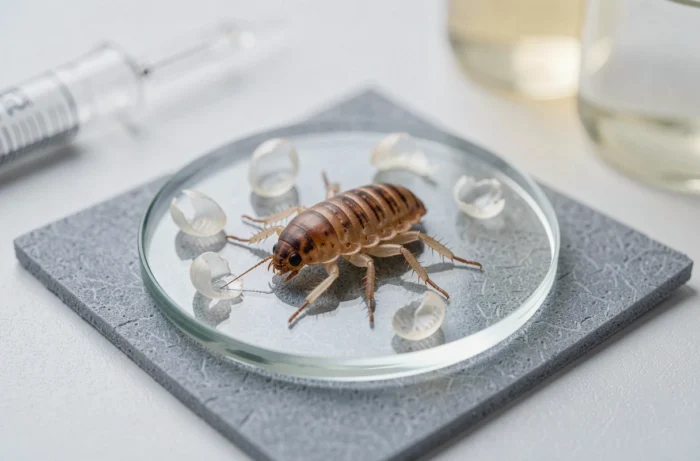
Absence of dead lice after treatment: a possible signal of failure
One expects to find dead parasites on the comb after applying a product. When nothing is found, there are two hypotheses: either there was no active infestation, or the treatment did not work.
The CDC specifies that if the lice remain as active as before the treatment, one should consider resistance to the product used. Permethrin-based products, long considered the standard, show decreasing effectiveness against what professionals call “super lice,” strains resistant to conventional insecticides.
Dimethicone works by mechanical suffocation, not by chemical action. It coats the louse and blocks its respiratory openings. This mode of action makes genetic resistance less likely, which explains why recent recommendations favor this approach.
When to resume control combing
One post-treatment combing is not enough. It is recommended to repeat the operation at regular intervals for at least two weeks to intercept any nymphs that may have emerged from surviving nits.
- First check in the days following the treatment, to remove dead lice and nits.
- Second pass about a week later, to capture nymphs that hatched in the meantime.
- Third check at the end of the second week, to confirm the total absence of living parasites.
It is this combing schedule that confirms the cure, not the crack perceived on the first day. A dry sound under the comb is reassuring, but it does not replace systematic observation on white paper. The true signal of the end of infestation is three consecutive combings with no living lice on the paper.